
Picture the world’s largest fish, the majestic whale shark (Rhincodon typus), gliding peacefully through the crystal-clear ocean. Its enormous, star-dusted body moves with a calm grace that seems almost unreal. Despite their size, these leviathans are not the ocean’s sprinters. They are the gentle giants of the sea, known more for their calm nature than for their speed. This naturally leads to a common question for anyone fascinated by these creatures: “So, exactly how fast do whale sharks swim?” Understanding their speed is not just a fun fact; it’s a key to unlocking the secrets of their biology. Their pace is directly linked to their unique filter-feeding habits and their ability to undertake some of the longest migrations in the animal kingdom. In this deep dive, we’ll explore the whale shark’s speed in detail. We will uncover why they move the way they do, compare their swimming ability to other marine animals, explore the science behind their movement, and debunk a few common myths about these magnificent fish.
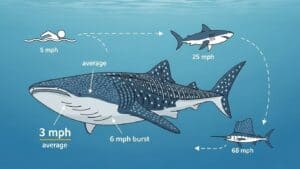
How Fast Do Whale Sharks Swim? (The Real Answer)
Let’s get straight to the point. If you’re looking for a quick answer, here it is: whale sharks are not built for speed. Their movement is slow, deliberate, and incredibly efficient.
- Average Cruising Speed: Whale sharks swim at a slow and steady pace of about 3 mph (5 km/h). This is their default, energy-efficient speed used for long-distance travel and feeding.
- Maximum Burst Speed: When they need to, such as to avoid a potential threat like a boat or an orca, they can achieve short bursts of speed up to 6 mph (9.7 km/h). However, they cannot maintain this pace for long.
This slow-and-steady approach is characteristic of a large, non-predatory animal. For a whale shark, the primary goal is not to chase but to endure. Their entire biology is geared towards energy conservation, allowing them to thrive on a diet of tiny organisms while covering vast oceanic territories.
Why So Slow? The Life of a Filter-Feeder
To understand the whale shark’s swim speed, you must first understand its lifestyle. Unlike most other sharks, the whale shark is a filter-feeder, a behavior that dictates almost every aspect of its existence, including how fast it swims.
Filter-Feeding Explained
Instead of hunting large prey, whale sharks swim with their enormous mouths wide open, gulping in massive volumes of water. Inside their mouths, specialized filter pads act like giant sieves, trapping plankton, small fish, shrimp, and fish eggs while allowing the water to pass out through their gills. This method of feeding doesn’t require chasing down fast-moving prey. The whale shark’s food is either slow-moving or simply drifts passively in the water column.
No Need for Speed
Predatory sharks, like the great white, need explosive speed to ambush and catch their agile prey. Their bodies are muscular torpedoes designed for acceleration and power. The whale shark, on the other hand, has no such need. Its food source is abundant but spread out, so its strategy is based on endurance, not attack. It’s more like a giant, mobile net than a hunter.
Energy Conservation is Key
Being the largest fish in the sea comes at a cost. A massive body requires a huge amount of energy just to function. By swimming slowly, whale sharks conserve precious calories. This low-energy lifestyle allows them to travel thousands of miles across oceans in search of dense patches of plankton, which can be unpredictable and far apart. Their slow pace is a feature, not a flaw, and is essential for their survival.
Whale Shark Speed vs. Other Marine Life
Putting the whale sharks’ swim into perspective helps highlight just how unique it is. Let’s compare its pace to some other well-known swimmers.
- Whale Shark vs. Human: An average person swims at about 2 mph, while an Olympic swimmer like Michael Phelps can hit speeds of 6 mph in short bursts. A strong swimmer could theoretically keep pace with a cruising whale shark for a while, but would be quickly left behind if the shark decided to put on a burst of speed. The shark’s endurance, however, is on another level entirely.
- Whale Shark vs. Great White Shark: This is where the difference between a filter-feeder and an apex predator becomes clear. The great white shark is built for speed, capable of reaching bursts of 25 mph (40 km/h). This incredible power allows it to launch surprise attacks on fast-moving prey like seals. The whale shark’s 3 mph cruising speed is no match.
- Whale Shark vs. Basking Shark: The basking shark is the second-largest fish and another filter-feeder. Its lifestyle is very similar to the whale shark’s, and so is its speed. The basking shark cruises at around 2.3 mph (3.7 km/h), reinforcing the strong link between a filter-feeding strategy and a slow pace.
- Whale Shark vs. Sailfish: To see the opposite end of the spectrum, consider the sailfish. Widely regarded as the ocean’s fastest fish, it can reach blistering speeds of over 68 mph (110 km/h). This contrast perfectly illustrates the vast diversity of evolutionary strategies in the marine world.
The Science of Movement: How Whale Sharks Swim
The whale shark’s anatomy and biomechanics are finely tuned for its slow-moving lifestyle, prioritizing stability and efficiency over raw speed.
Body Mechanics
Whale sharks swim by moving their entire body from side to side in a gentle, serpentine motion. This method of swimming, known as whole-body undulation, is less efficient for generating high speed compared to the method used by faster sharks. Predatory sharks, like makos and great whites, generate most of their power from their powerful tail fin (caudal fin), keeping their bodies relatively rigid. The whale shark’s way of moving is more suited for steady, continuous propulsion at low speeds.
Anatomy for Stability, Not Speed
- Streamlined Body: While their body is torpedo-shaped and streamlined to reduce drag, it’s optimized for steady, long-duration swimming rather than quick acceleration.
- Pectoral Fins: The large fins on their sides are not used for propulsion. Instead, they act like the wings of an airplane, providing lift, steering, and stability in the water.
- Buoyancy: Whale sharks have a massive, oily liver that helps them achieve near-neutral buoyancy. This allows them to “hang” effortlessly in the water column while feeding, saving a tremendous amount of energy.
How Do Scientists Measure Whale Shark Speed?
Our understanding of whale shark speed comes from decades of research using increasingly sophisticated technology. Marine biologists use several methods to track these giants and collect data on their movements.
- Satellite Tagging Studies: This is the most common and effective method. Scientists attach a satellite tag to a shark’s dorsal fin. These tags collect and transmit data on the shark’s location, depth, and water temperature. By analyzing the distance traveled over time, researchers can calculate their long-distance migration speeds and daily travel patterns.
- Acoustic Telemetry: For more localized studies, scientists tag sharks with acoustic transmitters. A network of underwater microphones (hydrophones) picks up the unique signal from each tag as the shark swims by, allowing researchers to track fine-scale movements within a specific area, like a feeding ground.
- Direct Observation & Drones: Divers and researchers on boats can directly observe and record short-term swimming behavior. More recently, drones have become an invaluable tool, providing a non-invasive way to film whale sharks from above, especially during surface feeding events, and calculate their speed with high accuracy.
Behavior and Movement Patterns
A whale shark’s speed isn’t constant; it changes based on what the shark is doing.
- Migration: Whale sharks are incredible travelers, undertaking some of the longest migrations of any marine animal. Their slow, steady cruising speed is the engine that powers these multi-thousand-kilometer journeys across entire ocean basins.
- Vertical Migration: These sharks often perform daily “vertical migrations.” They move from the deep ocean during the day to the surface at night, following the movement of their planktonic food source. Tagging studies have recorded them diving to astonishing depths of over 1,900 meters (6,230 feet). This shows their movement occurs in three dimensions, not just horizontally.
- Feeding: When actively feeding, especially at the surface in a plankton-rich area, a whale shark’s speed may slow down even further, sometimes to just 1-2 mph. At these times, their focus is on maximizing the volume of water they filter, not on covering distance.
Myths vs. Reality
The name “shark” often comes with some heavy baggage. Let’s clear up a few common misconceptions.
- Myth: Because they are “sharks,” they must be fast and dangerous.
- Reality: Whale sharks are the definition of gentle giants. They are incredibly slow, docile, and pose no threat to humans. In fact, snorkelers and divers often swim alongside them without any issue.
- Myth: Their huge size means they are powerful swimmers.
- Reality: Their size is an adaptation for efficient filter-feeding and energy storage, not for generating powerful, high-speed propulsion. In the ocean, power and size are not always linked to speed.
Frequently Asked Questions (FAQs)
How fast is a whale shark in mph?
A whale shark’s average cruising speed is about 3 mph (5 km/h). In short bursts, it can reach a maximum speed of around 6 mph (9.7 km/h).
Can a human swim faster than a whale shark?
An Olympic-level swimmer can match a whale shark’s top speed for a very short time. An average swimmer might keep up with its slow cruising speed, but not for long distances, as the shark’s endurance is far superior.
Why do whale sharks swim so slowly?
They swim slowly to conserve energy. As filter-feeders, they don’t need to chase prey. Their survival depends on efficiently traveling long distances through the ocean to find enough plankton to sustain their massive bodies.
Are whale sharks the slowest sharks?
While they are among the slowest, the title of the slowest shark likely goes to the Greenland shark, which lives in frigid Arctic waters and cruises at a glacial pace of less than 1 mph.
How does a whale shark’s size affect its speed?
Its large size creates more drag, which limits its top speed. However, that same size provides incredible momentum, making it highly efficient at maintaining a slow, steady pace over thousands of miles, much like a large cargo ship.
Do whale sharks swim fast when scared?
They can use a burst of speed up to 6 mph for short distances to evade a potential threat. However, their primary defense is not speed but their immense size and incredibly thick, tough skin.
What is the average speed of a whale shark when feeding?
When actively feeding, especially at the surface, a whale shark’s speed often drops to 1–2 mph. At these times, it is focused on taking in as much food-rich water as possible.
How deep do whale sharks swim?
Whale sharks are remarkable divers. Tagging studies have recorded them at depths of over 1,900 meters (more than 6,230 feet), which is over a mile deep!
How fast can a baby whale shark swim?
Baby whale sharks are very rarely seen in the wild, so data is limited. It is presumed their speed is proportionally slower than that of adults. Their main priorities are growing quickly and avoiding predators, not setting speed records.
What is the difference in speed between a whale shark and a great white?
A great white is an active predator built for speed, reaching up to 25 mph. A whale shark is a passive filter-feeder that cruises at just 3 mph. This huge difference reflects their completely different roles in the ocean ecosystem.
A Perfect Pace for a Gentle Giant
The whale shark’s speed is a perfect example of evolutionary adaptation at its finest. Its slow, deliberate pace is a feature, not a limitation. It is the key that enables its filter-feeding lifestyle, its remarkable energy efficiency, and its epic ocean-spanning migrations.
These gentle giants remind us that in the vast and diverse world of the ocean, there is more than one way to be a successful shark. Speed isn’t everything. Sometimes, the winning strategy is to be slow, steady, and built to endure.
If these magnificent creatures inspire you, consider learning more about whale shark conservation. Supporting organizations dedicated to protecting them and their habitats is the best way to ensure these gentle giants continue to grace our oceans for generations to come.