
The Atlantic Ocean is one of the most important and mysterious oceans in the world. It stretches between four major continents and has a deep impact on human civilization, weather patterns, marine life, and the global environment. Although many people know the basic facts about it, there are several unique and lesser-known realities that make this ocean truly fascinating. Let’s explore these interesting aspects.
It was once very small
Millions of years ago, the Atlantic Ocean did not exist in its present form. At that time, there was a massive supercontinent called Pangaea where all landmasses were connected. As tectonic plates began to move, the continents started drifting apart, forming a narrow sea passage that gradually expanded into today’s vast Atlantic Ocean. That is why, in geological terms, it is considered a relatively “young” ocean.
Its shape looks like the letter “S”
If you carefully observe the world map, the Atlantic Ocean appears somewhat similar to the English letter “S.” This is due to the positioning of continents — North and South America lie to the west, while Europe and Africa form its eastern boundaries. This unique structure influences ocean currents, wind directions, and even major shipping routes.
There are “dead zones” in some areas
Although the Atlantic Ocean is rich in marine life, certain regions have very low oxygen levels. These areas are known as dead zones, where it becomes difficult for sea creatures to survive. This problem usually occurs due to pollution, agricultural chemical runoff, and rising water temperatures.
There are underwater waterfalls 💧
It may sound surprising, but there are waterfalls beneath the Atlantic Ocean. In some regions, cold and dense water sinks below warmer water, creating a powerful downward flow. These underwater waterfalls can be much larger than those on land and play an important role in ocean circulation.
Huge garbage patches also form
Like other oceans, the Atlantic has regions where large amounts of plastic and waste accumulate. These areas are formed due to circular ocean currents known as gyres. This growing issue poses a serious threat to marine ecosystems and highlights the urgent need to protect our oceans.
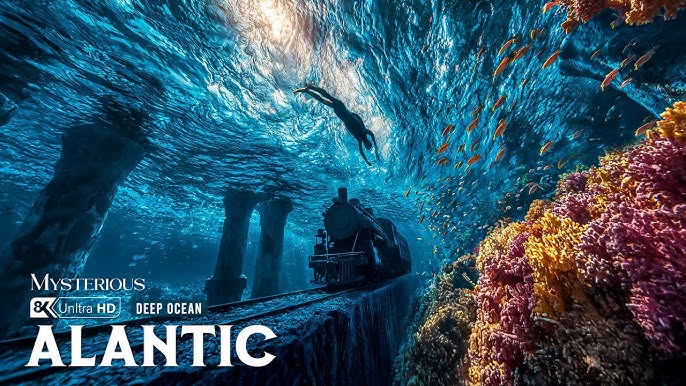
Creatures that glow in the dark
Sunlight cannot reach the deep ocean, yet it is not completely dark. Many marine organisms possess bioluminescence — the ability to produce their own light. Jellyfish, squids, and certain fish use this glow to attract prey or defend themselves. The scene often resembles a starry night beneath the water.
Ancient secrets lie on the ocean floor
Deep within the Atlantic Ocean are sunken ships, ancient remains, and fascinating geological formations. These hidden treasures tell stories of the past and help scientists learn more about human history, wars, and global trade routes.
Some waves can be as tall as buildings
During severe storms, waves in the Atlantic can become extremely high. Sometimes, sudden and unpredictable rogue waves rise more than 20 meters tall — higher than many buildings. Such waves pose serious dangers to ships and offshore structures.
Its colour changes with the seasons
Satellite images reveal that parts of the Atlantic Ocean change color depending on the season. This happens due to the growth of phytoplankton, tiny plant-like organisms that can make the water appear greenish or bluish. They also produce oxygen and form the foundation of the marine food chain.
It influences air travel too
The Atlantic Ocean is not only crucial for sea routes but also affects air travel. Powerful high-altitude winds known as jet streams flow above the ocean, influencing flight time and fuel efficiency. Pilots often plan routes by considering these wind patterns.
It plays a key role in storing carbon
The Atlantic absorbs large amounts of carbon dioxide from the atmosphere, helping reduce global warming. However, this process can increase ocean acidity, which may harm corals and shell-forming organisms.
New volcanic islands continue to form
The Atlantic Ocean is still geologically active. Sometimes underwater volcanic eruptions create new islands or expand existing ones. These natural events help scientists better understand Earth’s internal processes.
Conclusion
The Atlantic Ocean is not just a vast body of water but a living, ever-changing system that deeply influences life on Earth, global climate, and human progress. Its hidden waterfalls, glowing creatures, towering waves, and ancient mysteries continue to amaze and inspire us.