
We know more about the surface of Mars than we do about our own ocean floor. It is a staggering fact that highlights just how mysterious and unexplored our blue planet remains. The North Atlantic Ocean, a vast body of water separating the Americas from Europe and Africa, is not just a flat expanse of water; it is a deep, dynamic world filled with mountains, canyons, and layers of life that change drastically as you descend.From the sun-drenched surface where whales breach to the crushing darkness of the deep trenches where life survives against all odds, the North Atlantic is a marvel of nature. Understanding its structure helps us appreciate the delicate balance of Earth’s ecosystems.
The North Atlantic Ocean is divided into five major depth zones—epipelagic, mesopelagic, bathypelagic, abyssopelagic, and hadalpelagic. Each zone has different light levels, temperatures, pressures, and unique marine species adapted to survive there.
This guide serves as a comprehensive educational journey through these layers. Whether you are a student in the US, a marine enthusiast in the UK, or simply curious about the world beneath the waves, we will explore the specific environments and incredible creatures that define the North Atlantic.
North Atlantic Ocean Depth Zones (With Creatures in Each Zone)
When you look at the ocean from the beach or a boat, you are seeing only the “roof” of a massive, multi-story structure. Oceanographers and marine biologists view the ocean as a “layer cake” of distinct environments. These layers are defined not by physical barriers like walls, but by invisible shifts in the environment.
As you travel downwards, the water changes. It gets colder, darker, and heavier. The animals you find at 50 feet (15 meters) are vastly different from those you would find at 5,000 feet (1,500 meters). To make sense of this massive volume of water, scientists have categorized the ocean into five specific vertical zones.
What Are Depth Zones in the North Atlantic Ocean? (Simple Explanation)
Depth zones are layers of the ocean separated by sunlight penetration, temperature gradients, hydrostatic pressure, and the types of marine life found within them.
Why do scientists divide the ocean this way? It comes down to the primary source of energy for life on Earth: the sun. Sunlight can only penetrate water to a certain depth. Once the light is gone, the rules of survival change completely. Photosynthesis stops, temperatures drop near freezing, and animals must adapt to immense pressure.
The key entities that define these zones are
- Light Penetration: The photic (light) zone vs. the aphotic (no light) zone.
- Temperature Gradient: The rapid drop in temperature known as the thermocline.
- Pressure: The weight of the water column, which increases by one atmosphere for every 10 meters of depth.
Epipelagic Zone (0–200 m)—Sunlight Zone
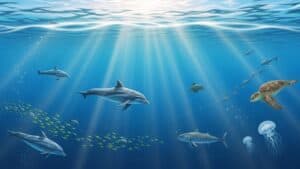 The epipelagic zone is the top layer of the ocean where sunlight is prominent, allowing for photosynthesis and supporting the vast majority of known marine life.Also known as the Sunlight Zone, this is the layer most familiar to humans. It extends from the surface down to about 200 meters (656 feet). In the North Atlantic, this zone is teeming with activity. Because sunlight can penetrate these waters, microscopic plants called phytoplankton can grow. These tiny organisms form the base of the ocean food web, feeding everything from small fish to massive whales.
Temperature & Conditions
This is the warmest zone in the North Atlantic Ocean. While surface temperatures vary based on latitude—warmer near the equator and freezing near the Arctic—the water here is constantly mixed by wind and waves, distributing heat.
The epipelagic zone is also oxygen-rich. Thanks to the churning of the waves and the photosynthetic activity of algae and phytoplankton, dissolved oxygen levels are high, which allows for fast-swimming, high-energy animals to thrive.
Pressure here is relatively low compared to the crushing depths below. At sea level, the pressure is 1 atmosphere (atm). At the bottom of this zone (200 meters), the pressure is about 20 atm. While that is significant, it is manageable for a wide variety of life forms, including human divers with the right equipment.
Creatures Found Here (Simple List)
Because food is abundant, the Sunlight Zone is crowded. In the North Atlantic, you will find:
- Atlantic Mackerel: Fast-swimming schooling fish that rely on plankton.
- Dolphins: Mammals that must surface to breathe but hunt in the upper waters.
- Sea Turtles: Specifically the Leatherback and Loggerhead, often found migrating through the Atlantic.
- Plankton: The tiny drifters (both plant and animal) that feed the ocean.
- Jellyfish: Drifting predators like the Lion’s Mane Jellyfish.
These creatures rely heavily on sight to hunt and navigate. The clear, sunlit waters allow predators to spot prey from a distance. Consequently, many fish here have developed “countershading”—dark backs and light bellies—to camouflage against the dark depths below or the bright sun above.
Mesopelagic Zone (200–1,000 m) — Twilight Zone
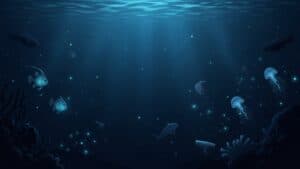
The mesopelagic zone is the layer where light fades rapidly; it is a dim environment often referred to as the Twilight Zone, located between 200 and 1,000 meters deep.
As you descend past 200 meters, the vibrant blue of the surface fades into a deep, dark indigo. There is still some light here, but it is not enough to support photosynthesis. It is a world of perpetual dusk.
Conditions
The “weak sunlight” environment defines this zone. You might be able to tell day from night in the upper reaches, but by the time you reach 1,000 meters, it is nearly pitch black.
This zone is also home to the thermocline. This is a transition layer where the temperature drops rapidly. While the surface water might be 20°C (68°F), the water at the bottom of the Twilight Zone drops to around 4°C (39°F).
Pressure continues to mount. At these depths, the weight of the water becomes dangerous for animals with gas-filled spaces (like swim bladders in fish). Many animals here have adapted by replacing gas with oils or water in their bodies to prevent being crushed.
Creatures Found Here
Life in the Twilight Zone is strange and wonderful. Animals here often migrate vertically—swimming up to the surface at night to feed and retreating to the dark depths during the day to hide.
- Lanternfish: Small fish that are incredibly abundant and distinct for their glowing bodies.
- Squid: Various species, including the cock-eyed squid, inhabit these waters.
- Snipe Eels: Long, slender eels with bird-like beaks.
- Hatchetfish: Extremely thin fish that use bioluminescence to hide their silhouettes.
This is where bioluminescence becomes a critical survival tool. Since the sunlight is dim, many animals produce their own light. Some use it to communicate, while others use it for “counter-illumination”—producing light on their bellies to match the faint light from above, making them invisible to predators looking up from below.
Bathypelagic Zone (1,000–4,000 m)—Midnight Zone
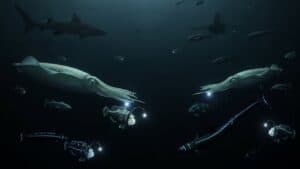
The bathypelagic zone is the layer of total darkness, characterized by near-freezing temperatures and intense hydrostatic pressure, extending from 1,000 to 4,000 meters.Welcome to the North Atlantic Ocean Midnight Zone. Here, the sun is gone completely. The only light in this vast stretch of the North Atlantic comes from the animals themselves. This zone makes up a massive volume of the ocean, yet it is one of the least explored ecosystems on the planet.
Conditions
The defining feature here is the aphotic nature of the water—meaning “without light.” Without sunlight, there is no plant life. The food web here does not start with fresh photosynthesis; it relies on “marine snow” (falling organic debris) or predation.
The water is uniformly cold, sitting just above freezing, usually between 1°C and 4°C.
The pressure is crushing, reaching up to 400 atmospheres. To put that in perspective, it would be like having a large elephant stand on your thumb. Human exploration here is impossible without heavy-duty submersibles like the Alvin or robotic vehicles (ROVs).
Creatures Found Here
To survive in the Midnight Zone, animals have evolved to be energy-efficient. Food is scarce, so they cannot afford to chase prey for miles. Instead, they use “sit-and-wait” strategies.
- Anglerfish: Famous for the glowing lure dangling from their heads to attract curious prey.
- Giant Squid: The legendary kraken of the deep, battling sperm whales in these depths.
- Gulper Eels: Eels with massive, hinge-like jaws that allow them to swallow prey larger than themselves.
- Deep-Sea Shrimp: often bright red in color. In the deep ocean, red light does not penetrate, so red animals appear distinctively black and invisible.
Metabolisms here are slow. Many fish have flabby muscles and weak skeletons because building dense bone and muscle takes too much energy. They drift, wait, and snap when a meal comes close.
Abyssopelagic Zone (4,000–6,000 m)—The Abys
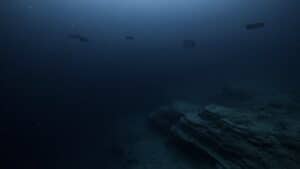 The Abyssopelagic Zone covers the vast majority of the North Atlantic seafloor, known as the abyssal plain, where organisms rely largely on scavenging.
The name comes from the Greek word abyssos, meaning “bottomless.” While it does have a bottom, the Abyss covers the massive, flat expanses of the ocean floor called abyssal plains. This is the largest ecosystem on Earth, covering more than 50% of the planet’s surface, yet it remains a silent, dark mystery.
Conditions
The environment is defined by three things: mud, silence, and cold. The floor is covered in a thick layer of sediment—the remains of millions of years of organic matter settling from above.
The primary food source is marine snow. This consists of dead plankton, fecal matter, and decaying animals drifting down from the sunlit surface miles above. It acts as a nutrient rain that feeds the bottom-dwellers.
The water is calm, unaffected by the storms raging on the surface of the North Atlantic. It is a place of stillness.
Creatures Found Here
You won’t find many fast swimmers here. The animals of the Abyss are mostly scavengers designed to sift through the mud or catch falling debris.
- Sea Cucumbers: These simple creatures are vacuum cleaners of the deep, marching in herds across the sediment.
- Basket Stars: Relatives of starfish with branching arms used to catch drifting particles.
- Amphipods: Tiny, shrimp-like crustaceans that can grow to surprising sizes (gigantism) in the deep.
These creatures have adapted to a life of scarcity. They are opportunistic, eating whatever falls their way.
Hadalpelagic Zone (6,000–11,000 m)—Deep Trenches
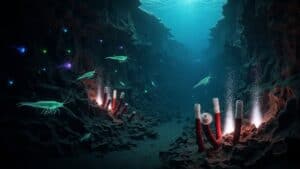
The Hadalpelagic Zone is the deepest, most extreme part of the ocean, found only in deep trenches and canyons like the Puerto Rico Trench. Named after Hades, the Greek underworld, this zone is strictly located in the deep oceanic trenches. In the North Atlantic, the most famous example is the Puerto Rico Trench, the deepest point in the entire Atlantic Ocean.
Conditions
The conditions here are almost alien. The pressure is extreme—reaching 8 tons per square inch. That is roughly equivalent to a single person trying to hold up 50 jumbo jets.
Because these trenches are geographically isolated from one another (separated by shallower abyssal plains), the ecosystems within them are often distinct. Animal species found in one trench may not exist in another, much like animals on isolated islands.
Creatures Found Here
Life exists here despite the crushing weight. It was once thought impossible for life to survive this deep, but we now know better.
- Snailfish: The deepest-living fish ever discovered are types of snailfish. They are translucent, scaleless, and gelatinous.
- Small Crustaceans: Amphipods thrive here, scavenging on any organic matter that falls into the trench.
- Microbial Life: Bacteria and single-celled organisms are abundant, processing chemicals in the sediment.
The animals here have unique biochemical adaptations. Their cells contain special proteins (piezolytes) that stop their cellular structures from collapsing under pressure.
How Depth Affects Marine Life in the North Atlantic (Clean Explanation)
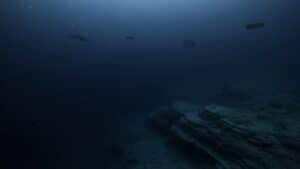
As you move from the surface to the trench floor, animals change in appearance and behavior. These changes are evolutionary solutions to the problems of light and pressure.
Marine life adapts via body shape, feeding methods, and eyesight to survive in specific depth zones.
Adaptations:
- Body Shape: In the deep ocean, you rarely see streamlined, muscular fish like tuna. Instead, deep-sea fish are often soft, watery, or jelly-like. This internal structure matches the density of the surrounding water, so they don’t get crushed. They lack air-filled cavities that would implode under pressure.
- Eyesight: In the epipelagic zone, eyes are normal. In the Twilight (Mesopelagic) zone, eyes are often huge and upward-facing to catch the faintest silhouettes of prey against the surface light. In the Midnight and Abyssal zones, many animals are completely blind—eyes are useless energy drains in total darkness.
- Bioluminescence: This is the ability of living things to produce light. In the deep North Atlantic, this is a superpower. Anglerfish use it as a lure. Deep-sea shrimp use it to vomit a cloud of glowing slime to distract predators. Hatchetfish use it to camouflage their shadows.
Table: North Atlantic Depth Zones & Example Creatures
| Depth Zone | Depth Range (Meters) | Depth Range (Feet) | Light Level | Key Conditions | Example Creatures |
| Epipelagic | 0 – 200m | 0 – 656 ft | Full Sunlight | Warm, Oxygen-rich, Low pressure | Atlantic Mackerel, Sea Turtles, Jellyfish |
| Mesopelagic | 200–1,000 m | 656–3,280 ft | Twilight (Dim) | Thermocline (temp drop), Moderate pressure | Lanternfish, Hatchetfish, Squid |
| Bathypelagic | 1,000 – 4,000m | 3,280–13 ft | Midnight (Dark) | Cold, High pressure, bioluminescence are common | Anglerfish, Gulper Eels, Giant Squid |
| Abyssopelagic | 4,000–60, | 13,120–19,685 ft | Pitch Black | Freezing, Crushing pressure, Marine snow | Sea Cucumbers, Basket Stars |
| Hadalpelagic | 6,000 – 11,000m | 19,685–36,000+ ft | Pitch Black | Extreme pressure, Isolated trenches | Snailfish, Amphipods, Microbes |
FAQs
Which is the deepest point in the North Atlantic Ocean?
The deepest point in the North Atlantic Ocean is the Milwaukee Deep, located within the Puerto Rico Trench. It reaches a staggering depth of approximately 8,380 meters (27,493 feet).
Can humans explore the deep North Atlantic?
Yes, humans can explore the deep North Atlantic, but only using specialized technology. Manned submersibles (like the one used to discover the Titanic wreck) and Remotely Operated Vehicles (ROVs) are required to withstand the immense pressure.
Why do animals glow in deeper zones?
Animals glow in deeper zones, a process called bioluminescence, for survival. They use this light to attract prey (like the anglerfish), find mates in the dark, or confuse predators with flashes of light or counter-illumination camouflage.
Which depth zone has the most marine life?
The epipelagic (sunlight) zone has the most marine life. Because sunlight penetrates this layer, photosynthesis can occur, creating an abundance of phytoplankton, which serves as the foundation for the entire ocean food web.
Summary
The North Atlantic Ocean has five distinct depth layers, ranging from the sunlit surface to the freezing trenches. Conditions change drastically regarding light, temperature, and pressure as you descend. Marine species have evolved specific, often bizarre adaptations to survive in their specific zone.
Exploring the Deep Blue
The journey from the sparkling waves of the North Atlantic to the silent, crushing depths of the Puerto Rico Trench is a journey into the unknown. We have seen that the ocean is not just water—it is a complex structure of layers, each with its own rules and residents.
From the dolphins playing in the sunlight to the snailfish surviving in the Hadal trenches, life finds a way. However, these ecosystems are fragile. Pollution, climate change, and deep-sea mining threaten these zones before we have even fully explored them.
Protecting the North Atlantic Ocean ecosystem is vital for the health of our planet. To learn more about how you can help, or to dive deeper into the science of marine biology, consider supporting ocean conservation organizations or visiting your local aquarium. The ocean is waiting to be understood.