
Imagine a creature the size of a school bus gliding effortlessly through the ocean, its enormous mouth agape as it filters the sea for food. This awe-inspiring sight belongs to the basking shark, the second-largest living fish on the planet. Despite its intimidating size, this creature is known affectionately as the “gentle giant” of the sea, a mysterious and peaceful marvel of the marine world.
This post will serve as your comprehensive guide to the basking shark. We will explore its unique biology, its fascinating behaviors, and the conservation challenges it currently faces. By the end, you will understand why this colossal fish is one of the most docile animals in the ocean, learning about its massive size, its filter-feeding method, and surprising facts about its teeth and habits.
What is a Basking Shark?
The basking shark, scientifically known as Cetorhinus maximus, is a slow-moving, placid giant that roams the world’s temperate and boreal waters. It is the only living species in the family Cetorhinidae. Despite a physical appearance that might seem formidable to some, it poses no threat to humans. Its common name comes from its tendency to “bask” near the surface of the water, slowly cruising as it feeds.
These sharks are often seen in coastal areas during the warmer months when plankton is abundant. They are generally solitary creatures but can occasionally be found traveling in pairs or small groups known as shoals. Their sheer size and distinct feeding posture make them one of the most recognizable and awe-inspiring sights in the ocean.
The Impressive Basking Shark Size
When discussing the Basking shark, its size is often the first thing that comes to mind. As the second-largest fish, trailing only the whale shark, its dimensions are truly staggering. On average, an adult basking shark measures around 26 feet (8 meters) in length and can weigh over 5 tons. However, much larger individuals have been recorded, with some reports suggesting lengths of over 40 feet (12 meters).
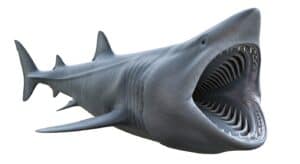
To put that into perspective, a fully grown basking shark can be as long as a small school bus. Its most prominent feature is its cavernous mouth, which can open to over 3 feet (1 meter) wide, allowing it to engulf vast quantities of water as it feeds.
Here are some of its key physical features:
- Enormous Mouth: A wide, gaping mouth that is central to its filter-feeding lifestyle.
- Prominent Gill Slits: Five pairs of massive gill slits that almost completely encircle its head, playing a crucial role in feeding.
- Crescent-Shaped Tail: A distinctive, large caudal (tail) fin that propels it slowly through the water.
- Rough Skin: Its skin is typically dark grey or brownish and has a rough, sandpaper-like texture due to dermal denticles, which are common to sharks.
A Filter-Feeder’s Feast: How Basking Sharks Eat
The basking shark is a filter-feeder, a feeding strategy shared by only two other shark species: the whale shark and the megamouth shark. It consumes zooplankton, which includes tiny crustaceans like copepods, as well as small fish and invertebrates. To eat, the shark swims slowly forward with its mouth wide open, a behavior known as ram filtration.
As water flows into its mouth and out through its gills, specialized structures called gill rakers trap the food. These long, bristle-like filaments are highly efficient, allowing a single basking shark to filter up to 2,000 tons of seawater per hour. After a period of feeding, the shark closes its mouth and swallows the accumulated plankton.
A common question is whether a basking shark’s mouth is ever closed. While they are famous for their open-mouthed feeding posture, they do close their mouths. When not actively feeding or when they need to swim more quickly to travel between feeding grounds, they keep their mouths shut.
Basking Sharks Have Teeth?
Given their filter-feeding diet, many people are surprised to learn that basking sharks do have teeth. However, these are not the formidable daggers you might associate with other sharks. Basking sharks’ teeth are tiny, measuring only about 5-6 millimeters in length. They have hundreds of these small, non-functional teeth arranged in several rows within their massive jaws.
Since these teeth are not used for biting or chewing, their exact purpose remains a bit of a mystery to scientists. One leading theory is that the teeth may play a role in courtship and mating, possibly helping a male shark grip onto a female during the process. They are certainly not used for feeding, which relies entirely on the gill rakers.
Behavior and Migration Patterns
Basking sharks are known for their slow, leisurely swimming speed, typically moving at about 2 miles per hour (3.2 km/h) while feeding. They are often seen near the surface, which allows them to access dense blooms of plankton.
These sharks are highly migratory. They follow seasonal plankton blooms, moving toward coastal areas in the spring and summer to feed. As winter approaches and surface food becomes scarce, they migrate to deeper waters, sometimes descending to depths of 3,000 feet (900 meters) or more. For a long time, it was thought they hibernated on the seafloor during winter, but modern tracking studies have revealed these extensive deep-water migrations. Some populations travel thousands of miles, crossing entire ocean basins.
A Notable Incident: The Cape Cod Basking Shark Stranding
While basking sharks are creatures of the open ocean, they sometimes find themselves in distress near the shore. A basking shark stranding occurs when the animal washes up on a beach or gets trapped in shallow water, unable to return to its deep-water habitat. These events can happen due to illness, injury, disorientation from unusual weather, or navigational errors.
The coastline of Cape Cod, Massachusetts, has seen several such incidents. When a massive animal like a basking shark becomes stranded, it is a significant event that draws the attention of marine biologists, conservation groups, and the public. Responding to a Cape Cod basking shark stranding is a challenging task due to the animal’s immense size and weight. Efforts are focused on assessing the shark’s health and, if possible, guiding it back to deeper water. Unfortunately, by the time a large marine animal strands, it is often too sick or injured to survive.
These strandings, while tragic, provide invaluable opportunities for scientists to study these elusive creatures up close. Researchers can collect biological samples to learn more about the shark’s genetics, diet, and health. If you ever encounter a stranded marine animal, the most important thing to do is to keep a safe distance and immediately contact local marine animal rescue organizations. Do not attempt to push the animal back into the water, as this can cause further injury to both the animal and you.
Conservation Status and Threats
The basking shark is a vulnerable species. The International Union for Conservation of Nature (IUCN) lists it as “Endangered” on its Red List of Threatened Species. Their populations have declined significantly over the past century due to a variety of human-induced threats.
The primary threats to basking sharks include:
- Historical Overfishing: For centuries, basking sharks were hunted for their enormous, oil-rich livers, which were used for lamp oil, lubricants, and even cosmetics. They were also fished for their meat and large fins, which are highly valued in the shark fin soup trade.
- Bycatch: Basking sharks are frequently caught accidentally in commercial fishing gear, such as trawl nets and gillnets, set for other species. Their large size and slow swimming speed make them particularly susceptible to entanglement.
- Boat Strikes: Because they spend so much time near the surface, basking sharks are vulnerable to collisions with boats and ships. These strikes can cause severe or fatal injuries.
- Marine Debris: Plastic pollution and other marine debris can be ingested by filter-feeding animals or cause entanglement, leading to injury, starvation, and death.
Fortunately, conservation efforts are underway to protect the remaining basking shark populations. They are now legally protected in many parts of their range, including the waters of the European Union, the United Kingdom, the United States, and New Zealand. Continued research, public awareness campaigns, and international cooperation are essential to ensure the survival of these gentle giants for future generations.
Frequently Asked Questions about Basking Sharks
Are basking sharks dangerous?
No, basking sharks are not dangerous to humans. They are passive, non-aggressive filter-feeders with no interest in humans as a food source. Their gentle nature is one of their most defining characteristics.
Do basking sharks bite?
Basking sharks do not bite in the predatory sense. Their feeding mechanism is designed solely for filtering tiny organisms from the water. While they have a mouth, they do not use it to attack or bite larger prey.
Do basking sharks have teeth?
Yes, basking sharks do have teeth, but they are extremely small and not used for feeding. They possess hundreds of these tiny, hook-like teeth, but their function is not fully understood and is likely related to behaviors other than eating.
Appreciating the Ocean’s Gentle Giants
The basking shark is a magnificent creature that embodies the gentle side of the shark world. It is a massive, harmless, and slow-moving fish that plays a vital role in its marine ecosystem. By understanding its biology and the threats it faces, we can better appreciate why it is so crucial to protect these incredible animals.
Their peaceful nature and awe-inspiring presence are a reminder of the diversity and wonder of life in our oceans. If you want to learn more about how you can help protect basking sharks and other marine life, consider supporting organizations dedicated to marine conservation.