
Introduction
The basking shark vs whale shark debate fascinates marine enthusiasts worldwide. While both rank among Earth’s largest fish, the difference between basking shark and whale shark extends far beyond size. This comprehensive basking shark comparison explores how these gentle filter-feeding giants differ in appearance, habitat, behavior, and biology. Understanding basking shark vs whale shark differences helps identify these magnificent creatures during ocean encounters. From basking shark vs whale shark size variations to habitat preferences, we’ll examine what makes each species unique. We’ll also explore basking shark vs great white shark distinctions and basking shark vs manta ray comparisons, providing the complete largest fish comparison guide.
Size Showdown
Which is Bigger basking shark Vs whale shark?
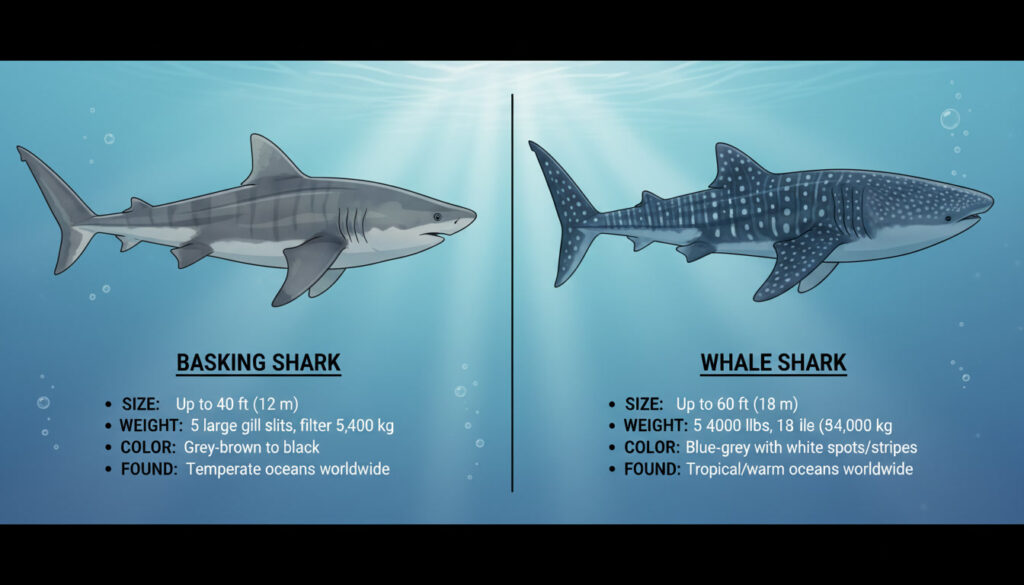
Which is bigger basking shark or whale shark? The whale shark claims the title as the world’s largest fish, reaching maximum lengths of 18-20 meters (59-66 feet). Basking sharks rank second, growing to impressive 12 meters (40 feet) with rare individuals reaching 14 meters.
Weight differences prove even more dramatic. Whale sharks can exceed 20 tons, while basking sharks typically reach 6-8 tons maximum. Despite the basking shark’s massive proportions, whale sharks outweigh them by 2-3 times at comparable lengths.
The basking shark vs whale shark size comparison reveals interesting growth patterns. Whale sharks grow larger overall, but basking sharks achieve impressive dimensions relative to their temperate habitat’s productivity. Both species continue growing throughout life, with age determining ultimate size more than any other factor.
Mouth and Gill Differences basking shark Vs whale shark
Both species feature enormous mouths for filter-feeding, but designs differ significantly. Whale shark mouths measure up to 1.5 meters wide positioned at the head’s front (terminal). Basking shark mouths, while equally impressive, sit slightly underneath the snout (subterminal) and can expand dramatically during feeding.
Basking shark gill slits nearly encircle the entire head—their most distinctive feature. These enormous slits extend from throat to nearly the top of the head. Whale shark gills, though large, don’t approach this extreme proportion, appearing more conventionally positioned.
Appearance Differences
Coloration and Patterns basking shark Vs whale shark
The most obvious difference between basking shark and whale shark lies in coloration. Whale sharks display stunning checkerboard patterns—light spots and stripes against dark blue-grey backgrounds. Each individual has unique spot patterns, like fingerprints, enabling researchers to identify specific sharks.
Basking sharks appear uniformly grey-brown to slate-grey dorsally with lighter undersides. No spots, stripes, or distinctive markings exist—just solid coloration sometimes appearing mottled from parasites, scars, or algae growth. Their plain appearance contrasts dramatically with whale sharks’ photogenic patterns.
Body Shape and Features
Basking shark vs whale shark appearance includes body shape variations. Basking sharks have more elongated, torpedo-shaped bodies with pronounced conical snouts. Their dorsal fins appear tall and triangular, often followed by a smaller second dorsal fin.
Whale sharks possess broader, more robust bodies with flattened heads and wider snouts. Their dorsal fins sit further back and appear relatively smaller proportionate to body size. The caudal (tail) fin shape differs too—whale sharks have distinctive half-moon shaped tails while basking sharks’ tails appear more lunate with pronounced upper lobes.
Skin Texture
Both species have rough skin covered in dermal denticles (tooth-like scales), but textures differ. Whale shark skin reaches 15cm thick in places—the thickest of any animal. Basking shark skin, while tough, doesn’t achieve these extreme dimensions.
Habitat and Range
Geographic Distribution
Basking shark vs whale shark habitat preferences diverge dramatically. Whale sharks inhabit tropical and warm temperate waters worldwide—found in all tropical oceans between 30°N and 35°S. They prefer temperatures above 21°C (70°F), rarely venturing into cold waters.
Basking sharks prefer temperate and cold waters, thriving in temperatures 8-14°C (46-57°F). They range throughout the North Atlantic, North Pacific, and temperate Southern Hemisphere waters. Some populations undertake extensive migrations following seasonal plankton blooms.
The habitat separation means you’ll never find both species in the same waters simultaneously. Tropical divers encounter whale sharks, while temperate coast visitors see basking sharks. This geographic segregation reduces competition for plankton resources.
Depth Preferences
Both species feed primarily at or near the surface when plankton concentrates there. However, diving behaviors differ significantly. Whale sharks regularly dive to 1,000+ meters, with maximum recorded depths exceeding 1,900 meters. These deep excursions may relate to feeding on deep-scattering layers or thermoregulation.
Basking sharks also dive deep—satellite tags record depths exceeding 1,000 meters. However, their deep-diving patterns appear different from whale sharks’, possibly relating to overwintering behavior or traveling between feeding grounds. Surface feeding dominates their observable behavior during productive seasons.
Feeding Behavior
Filter-Feeding Techniques
The basking shark Vs whale shark filter feeding sharks comparison reveals fascinating technical differences. Basking sharks employ ram filter-feeding—swimming forward with mouths agape, passively straining water through gill rakers. They process approximately 2,000 tons of water hourly at feeding speeds of 2-4 km/h.
Whale sharks use both ram filtering and active suction feeding. They can pause, position vertically, and actively gulp water, processing prey more selectively. This versatility allows whale sharks to exploit various plankton concentrations and depths more effectively than basking sharks’ passive method.
Prey Preferences
Both species consume zooplankton, but preferences differ. Basking sharks primarily target copepods—tiny crustaceans forming dense clouds in temperate waters. They also consume fish eggs, larval fish, and other small organisms when available.
Whale sharks eat more diverse prey including krill, small fish, fish eggs, squid, and even small crustaceans. Their tropical habitat offers greater prey diversity year-round compared to temperate ecosystems’ seasonal productivity. Whale sharks sometimes aggregate at fish spawning events, exploiting massive egg releases.
Behavior and Temperament
Social Patterns
Whale sharks often appear solitary but aggregate at productive feeding sites. Seasonal gatherings at locations like Ningaloo Reef (Australia), Isla Mujeres (Mexico), and various Philippine sites can include dozens of individuals feeding simultaneously.
Basking shark social behavior includes similar aggregations in plankton-rich areas. Scottish waters, the Isle of Man, and parts of the Northeast US regularly host groups of 20-50+ sharks during peak season. Both species tolerate conspecifics without aggression during these gatherings.
Human Interactions
Both species demonstrate remarkable tolerance toward humans. Whale sharks allow swimmers and divers to approach closely, sometimes appearing curious about humans. Tourism industries worldwide offer whale shark swimming experiences.
Basking sharks similarly tolerate human presence, though encounters occur less frequently due to their temperate habitat and colder water temperatures deterring casual swimmers. Both species pose zero danger—their filter-feeding biology and gentle temperaments make them completely safe.
Basking Shark vs Great White
Size and Appearance
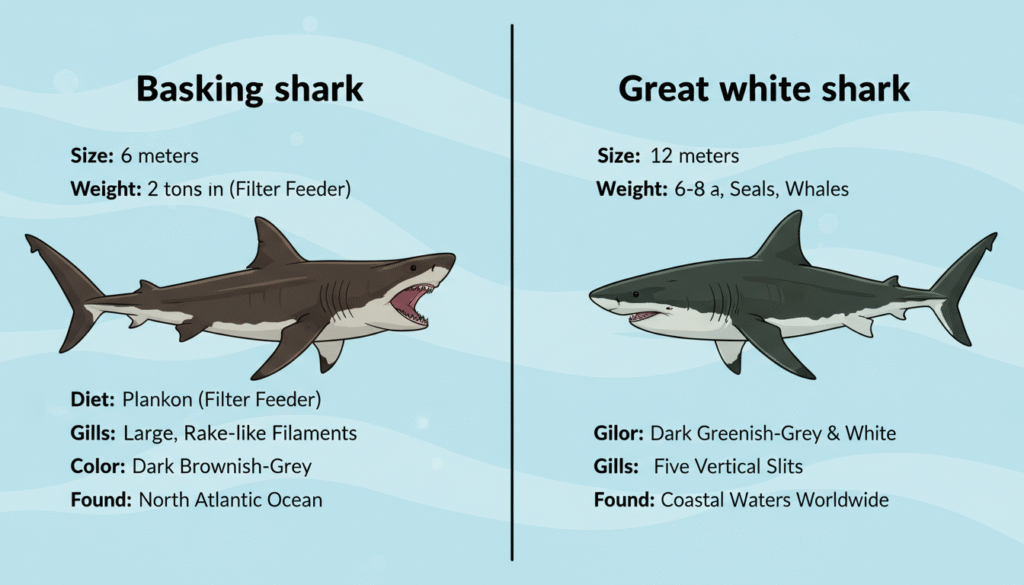
The basking shark vs great white comparison reveals dramatically different animals despite both being large sharks. Great whites max out around 6 meters (20 feet) and 2 tons—significantly smaller than basking sharks’ 12-meter, 6-8 ton dimensions.
Great whites have fusiform, muscular bodies with powerful jaws filled with serrated teeth. Basking sharks appear more elongated with distinctive enormous mouths lacking functional teeth in adults. The physical differences reflect completely different feeding ecologies.
Diet and Behavior
Great white sharks are apex predators hunting seals, sea lions, fish, and occasionally dolphins. They use speed, power, and sharp teeth to capture and consume prey. This predatory lifestyle contrasts completely with basking sharks’ peaceful plankton filtering.
Great whites can exhibit aggressive behavior when hunting, defending territories, or feeling threatened. Basking sharks never display aggression—their gentle temperament remains consistent across all observed situations. The behavioral gulf between these species couldn’t be wider despite sharing shark classification.
Basking Shark vs Manta Ray
Taxonomic Differences
The basking shark vs manta ray comparison involves different taxonomic groups. Basking sharks are true sharks (Chondrichthyes: Elasmobranchii: Lamniformes). Manta rays belong to the batoid group (related to sharks but distinct), specifically Myliobatidae family.
Physical differences immediately distinguish them. Manta rays have flattened, disc-shaped bodies with wing-like pectoral fins and cephalic fins (“horns”) flanking their mouths. Basking sharks maintain typical shark body plans—cylindrical bodies, vertical tail fins, and conventional shark profiles.
Size Comparison
Giant manta rays reach impressive 7-meter wingspans and weigh up to 3 tons—large for rays but smaller than basking sharks. Reef mantas max out around 5 meters. The largest fish comparison always places basking sharks well above manta rays in both length and mass.
Feeding Similarities
Despite anatomical differences, both are filter-feeders consuming plankton. Manta rays use their cephalic fins to channel water into their mouths while swimming. Specialized filtering structures trap plankton as water passes through gill arches.
This convergent evolution—different species developing similar feeding strategies—demonstrates how productive ocean habitats support multiple large filter-feeding species. Each species occupies slightly different niches, reducing direct competition.
Conservation Status
Protection Levels
Both basking sharks and whale sharks face endangerment. Basking sharks are listed as Endangered globally on the IUCN Red List. Whale sharks also carry Endangered status, reflecting population declines from historical fishing and ongoing threats.
Both species receive CITES Appendix II protection regulating international trade. Many countries prohibit fishing or harassment. However, enforcement varies, and threats including bycatch, vessel strikes, and habitat degradation persist for both species.
Population Trends
Basking shark populations show regional recovery signs in well-protected areas like Northeast Atlantic waters. Whale shark populations appear stable in some regions but declining in others, particularly areas with ongoing fishing pressure or heavy boat traffic.
Long-term survival requires continued protection, threat mitigation, and habitat conservation for both species. Their slow reproductive rates—both reach maturity late and produce few offspring—mean population recovery requires decades even with perfect protection.
Research and Study
Tracking Technology
Scientists study both species using satellite tags, photo-identification, and genetic analysis. Whale shark research benefits from warmer waters making fieldwork more accessible. Basking shark research in cold temperate waters presents additional challenges.
Both species undertake remarkable migrations tracked through satellite telemetry. Whale sharks travel between tropical feeding grounds, sometimes crossing entire ocean basins. Basking sharks migrate extensively too, with individuals moving between European and North American waters or diving to great depths during winter.
Conservation Challenges
Understanding these species’ complete life cycles remains challenging. Critical questions about breeding locations, gestation periods, and early life stages persist. Solving these mysteries requires continued research investment and international cooperation since both species cross numerous national boundaries.
Identifying in the Wild
When encountering large filter-feeding sharks, look for these quick identification markers: tropical waters with spotted patterns = whale shark; temperate/cold waters with plain grey coloring and massive gill slits = basking shark. The habitat alone usually confirms species before observing physical features.
Both create unforgettable wildlife encounters. Understanding their differences enhances appreciation for each species’ unique adaptations to their respective ocean realms. These gentle giants represent evolutionary success stories deserving our protection and admiration.
Ecotourism Opportunities
Whale shark tourism thrives in tropical destinations worldwide. Basking shark watching concentrates in temperate regions like Scotland, Ireland, Cornwall, and New England. Both activities support local economies while funding conservation through entrance fees, tour revenues, and increased stakeholder investment in protection.
Responsible tourism following ethical guidelines ensures these experiences remain sustainable. Maintaining distance, limiting encounter duration, and never touching sharks protects both animals and ensures future generations enjoy similar opportunities.
Conclusion
The basking shark vs whale shark comparison reveals two magnificent species perfectly adapted to different ocean realms. While whale sharks claim the largest fish title, basking sharks dominate temperate waters as the second-largest species. Understanding their differences in size, appearance, habitat, and behavior enhances appreciation for both. These gentle filter-feeding giants deserve our protection, respect, and continued conservation efforts worldwide.
Frequently Asked Questions
Q1: Which is bigger, basking shark or whale shark? Whale sharks are bigger, reaching 18-20 meters (59-66 feet) and over 20 tons, making them the world’s largest fish. Basking sharks rank second at up to 12 meters (40 feet) and 6-8 tons. Despite their massive size, basking sharks are significantly smaller than whale sharks.
Q2: What is the main difference between basking shark and whale shark? The main differences are coloration and habitat. Whale sharks have distinctive spotted patterns and live in tropical waters (21°C+). Basking sharks appear uniformly grey and inhabit cold temperate waters (8-14°C). They never coexist in the same waters due to these temperature preferences.
Q3: Are basking sharks and whale sharks related? Yes, both are sharks (Chondrichthyes class) and filter-feeders, but they belong to different orders. Whale sharks are Orectolobiformes (carpet sharks), while basking sharks are Lamniformes (mackerel sharks). They’re distantly related cousins who evolved similar feeding strategies independently.
Q4: Can you swim with basking sharks like whale sharks? Yes, you can swim with basking sharks in regions like Scotland, Ireland, and parts of Canada. However, it’s less common than whale shark tourism due to colder water temperatures requiring wetsuits. Both species are equally gentle and safe around humans.
Q5: How do basking sharks compare to great white sharks? Basking sharks are much larger (12m vs 6m), peaceful filter-feeders eating only plankton. Great whites are predatory apex hunters eating seals and fish. Despite being sharks, they have completely different diets, behaviors, and temperaments. Basking sharks pose zero danger to humans.
Q6: Do basking sharks and whale sharks ever meet? No, basking sharks and whale sharks never naturally encounter each other. Whale sharks inhabit tropical waters worldwide, while basking sharks prefer cold temperate seas. Their geographic ranges don’t overlap due to completely different temperature preferences separating their habitats.
Q7: Which shark is more endangered? Both basking sharks and whale sharks are listed as Endangered on the IUCN Red List. Both face similar threats including historical overfishing, bycatch, vessel strikes, and climate change. Conservation status is roughly equal, though regional population trends vary between species and locations.