
basking sharks
Despite being the world’s second-largest fish reaching 40 feet in length, basking sharks consume only microscopic organisms invisible to the naked eye. These gentle giants feed exclusively on zooplankton—tiny drifting animals including copepods, barnacle larvae, fish eggs, and krill—filtering them from thousands of tons of seawater daily through an extraordinary feeding mechanism that ranks among nature’s most impressive evolutionary adaptations. Understanding the basking shark diet and their unique filter feeding process reveals fascinating insights into marine ecosystems, ocean food chains, and how the planet’s largest creatures can thrive on the smallest prey. This comprehensive guide explores exactly what basking sharks eat, how their filter-feeding mechanism works, daily consumption rates, seasonal feeding patterns, and how they compare to other filter-feeding sharks like whale sharks and megamouth sharks.
Whether you’re researching marine biology, planning to observe basking sharks in the wild, or simply curious about ocean wildlife, this complete basking shark feeding behavior guide provides scientifically accurate, detailed information about one of the ocean’s most specialized feeders.
What Do Basking Sharks Eat? Quick Answer
Basking sharks eat exclusively zooplankton—microscopic to small animals that drift with ocean currents. Their entire diet consists of:
✓ Copepods (tiny crustaceans, 1-5mm) – primary food source ✓ Barnacle larvae – seasonal abundance during spawning ✓ Decapod larvae (crab, lobster, shrimp larvae) ✓ Fish eggs and larvae – particularly during mass spawning events ✓ Krill and small shrimp ✓ Other zooplankton (arrow worms, pteropods, sea butterflies)
Important: Basking sharks consume zero phytoplankton (plant plankton/algae), focusing exclusively on animal-based zooplankton for protein and fat content essential to their metabolism.
Daily Consumption: Approximately 2,000 pounds (900 kg) of plankton to meet metabolic needs Water Filtered: Up to 2,000 tons per hour during active feeding Feeding Method: Passive ram filter feeding (swimming forward with mouth open)
Basking Shark Diet: Complete Plankton Menu
Primary Food: Copepods
Copepods form the foundation of the basking shark diet in most temperate waters. These tiny crustaceans measure just 1-5 millimeters yet occur in such extraordinary densities that they provide sufficient nutrition for the world’s second-largest fish.
Copepod Characteristics:
- Size: 1-5mm (barely visible to human eye)
- Abundance: Can reach densities of 10,000+ individuals per cubic meter during blooms
- Nutrition: High in protein and lipids (fats)
- Availability: Year-round, with peak abundance spring/summer
Copepods represent the most abundant animal biomass in many ocean regions, making them a reliable food source for basking sharks. A single mouthful of plankton-rich water during peak bloom conditions may contain thousands of copepods.
Barnacle Larvae (Nauplii and Cyprid Stages)
During spring and early summer, barnacle reproduction creates massive releases of larvae into coastal waters. These larvae drift as plankton before settling on rocks and other surfaces.
Why Barnacle Larvae Matter:
- Seasonal superabundance creates feeding opportunities
- Larger than copepods (up to 2mm at cyprid stage)
- Nutrient-dense for growth and energy
- Predictable timing attracts basking sharks to coastal areas
Basking sharks often aggregate in areas experiencing barnacle spawning events, taking advantage of these temporary but abundant food sources.
Decapod Larvae (Crab, Lobster, Shrimp)
The larval stages of crabs, lobsters, and shrimp spend weeks to months drifting in plankton before settling to the seafloor. These protein-rich larvae provide excellent nutrition.
Decapod Larvae Features:
- Size: 2-10mm depending on species and developmental stage
- Higher protein content than many plankton types
- Available throughout spring, summer, and early autumn
- Concentrated in coastal shelf waters where adults reproduce
Fish Eggs and Larvae
When fish species undergo mass spawning events, their eggs and newly hatched larvae create dense plankton clouds that attract basking sharks.
Notable Spawning Events:
- Herring spawning (creates massive egg and larvae concentrations)
- Capelin spawning in northern waters
- Various flatfish spawning on continental shelves
- Small pelagic fish (anchovies, sardines) spawning
Fish eggs measure 1-3mm, while larvae range from 3-20mm depending on species. Both provide high nutritional value with substantial protein and fat content.
Krill and Small Shrimp
While not the primary diet component in most regions, krill (small shrimp-like crustaceans) supplement basking shark nutrition when abundant.
Krill Characteristics:
- Size: 10-25mm (larger than most basking shark prey)
- Occur in dense swarms in some regions
- High in protein, fats, and astaxanthin (provides pink coloration)
- More common in polar and subpolar waters
Other Zooplankton
The basking shark diet includes various other microscopic organisms:
Chaetognaths (Arrow Worms):
- Transparent, worm-like predatory zooplankton
- Size: 5-20mm
- Abundant in temperate waters
Pteropods (Sea Butterflies):
- Small swimming snails with wing-like appendages
- Size: 3-10mm
- Particularly abundant in cold temperate waters
Amphipods:
- Small crustaceans resembling tiny shrimp
- Size: 5-15mm
- Found throughout water column
Jellyfish Larvae (Ephyrae):
- Early developmental stages of jellyfish
- Size: 2-5mm
- Seasonal availability
How Basking Sharks Filter Feed: Step-by-Step Process
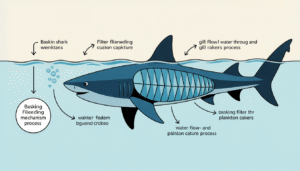
The basking shark feeding mechanism represents a masterpiece of evolutionary engineering—a passive system requiring minimal energy while processing enormous water volumes.
Step 1: Opening the Mouth
As a basking shark approaches plankton-rich water, it opens its massive mouth to approximately 3 feet (1 meter) in diameter—wide enough for a small adult human to fit inside (though this would never happen, as basking sharks avoid large objects).
Mouth Opening Mechanics:
- Jaw muscles relax, allowing gravity and water pressure to open mouth
- Minimal energy expenditure (passive opening)
- Can maintain open position for extended periods without fatigue
- Adjustable gape allows response to plankton density
Step 2: Water Intake (Ram Filter Feeding)
Unlike some filter feeders that actively suck water, basking sharks use ram filtration—swimming forward pushes water into their open mouths through simple forward motion.
Swimming Speed During Feeding:
- Typical: 2-3 mph (3-5 km/h)
- Optimal for water flow without excessive energy use
- Slower than normal cruising speed
- Maintains steady, consistent water intake
Water Volume: Basking sharks can process up to 2,000 tons (1.8 million liters or 475,000 gallons) of water per hour during active feeding. Over a typical 6-hour feeding session, a single shark might filter through 12,000 tons of water—enough to fill five Olympic swimming pools.
Step 3: Filtration Through Gill Rakers
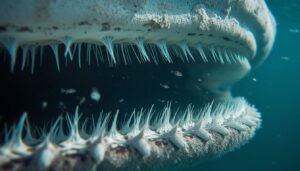 As water flows through the mouth, it passes over the gills where specialized structures called gill rakers perform the actual filtration.
Gill Raker Structure:
- Dark, bristle-like projections lining each gill arch
- Create a fine mesh capable of trapping particles as small as 1-2mm
- Thousands of individual rakers per shark
- Flexible yet strong enough to withstand constant water flow
Filtration Mechanism:
- Water enters mouth and flows toward gills
- Gill rakers form a sieve-like barrier
- Plankton particles too large to pass through rakers are trapped
- Clean water flows through rakers and exits via gill slits
- Trapped plankton accumulates on raker surface
Step 4: Swallowing Accumulated Plankton
After approximately one minute of continuous filtering, the basking shark closes its mouth momentarily to swallow the plankton accumulated on its gill rakers.
Swallowing Process:
- Mouth closes, reducing water flow
- Throat muscles contract, directing plankton toward esophagus
- Small amount of water swallowed with plankton
- Process takes 5-10 seconds
- Mouth reopens to resume filtering
This cycle repeats continuously during feeding sessions, with sharks opening and closing their mouths in a rhythmic pattern—open for ~60 seconds, closed for ~5-10 seconds.
Step 5: Continuous Repetition
During peak feeding periods, basking sharks may feed for 6-8 hours continuously, repeating this open-filter-close-swallow cycle hundreds of times to extract sufficient nutrition from plankton-laden water.
Gill Rakers: The Filtering Mechanism Explained
Gill rakers are the key anatomical feature enabling basking shark filter feeding—without these specialized structures, the filter-feeding lifestyle would be impossible.
Structure and Function
Physical Characteristics:
- Location: Lining interior of each gill arch (5 gill arches total)
- Appearance: Dark brown/black bristle-like projections
- Length: Several millimeters each
- Number: Thousands per shark
- Arrangement: Dense, overlapping configuration creating fine mesh
Mesh Size and Efficiency: The gill raker mesh can trap plankton particles as small as 1-2 millimeters, though optimal efficiency occurs with prey measuring 2-5mm. This size range perfectly captures copepods, barnacle larvae, and other primary prey while allowing smaller particles to pass through (reducing clogging and maintaining water flow).
Seasonal Gill Raker Shedding
One of the most intriguing aspects of basking shark biology involves seasonal gill raker shedding—a phenomenon still being researched by scientists.
The Mystery: Some research suggests basking sharks may shed their gill rakers during winter months when plankton abundance decreases dramatically. This would render them unable to feed, potentially explaining why basking sharks largely disappear from coastal waters in winter.
Alternative Hypothesis: More recent tagging studies show basking sharks remain active year-round, diving to depths of 600-3,000 feet during winter to feed on deep-water zooplankton. This suggests gill rakers may not be shed, or shedding may be gradual replacement rather than complete loss.
Current Scientific Understanding: The gill raker shedding question remains partially unresolved, with ongoing research using satellite tags and underwater cameras to better understand winter behavior and feeding.
How Much Do Basking Sharks Eat Daily?
Water Volume Processed
During active feeding, basking sharks filter extraordinary water volumes:
Hourly Rate:
- Maximum: 2,000 tons (1.8 million liters) per hour
- Typical: 1,500 tons per hour during normal feeding
- Variable: Depends on plankton density and swimming speed
Daily Volume: Assuming 6 hours of active feeding (typical during peak season):
- Total water filtered: 9,000-12,000 tons per day
- Gallons: 2.4-3.2 million gallons
- Comparison: Enough to fill 4-5 Olympic swimming pools
Plankton Weight Consumed
Given that plankton concentrations typically range from 0.1-1.0 grams per cubic meter of water (with higher concentrations during blooms), basking sharks must process enormous water volumes to extract sufficient nutrition.
Estimated Daily Plankton Intake:
- Weight: Approximately 2,000 pounds (900 kg) of wet plankton
- Dry weight: ~400-500 pounds (180-225 kg) after water removed
- Caloric value: Roughly 400,000-500,000 calories
Caloric Requirements
Metabolic Needs: Basking sharks, like all fish, are ectothermic (cold-blooded), meaning they don’t expend energy maintaining body temperature like mammals. This significantly reduces caloric requirements compared to warm-blooded animals of similar size.
Daily Energy Budget:
- Basal Metabolic Rate: ~300,000-400,000 calories for maintenance
- Swimming: ~50,000-100,000 additional calories
- Growth/Reproduction: Variable, especially in pregnant females
- Total: ~400,000-600,000 calories daily
The 2,000 pounds of plankton consumed provides sufficient calories to meet these needs, though basking sharks likely fast during periods of low plankton availability (winter months in some regions).
Feeding Efficiency
Challenge: Extracting 2,000 pounds of plankton requires filtering 9,000-12,000 tons of water—a remarkable feat of biological engineering.
Efficiency Factors:
- Plankton Density: Higher concentrations mean less water needed
- Gill Raker Mesh: Optimal spacing balances capture efficiency with water flow
- Swimming Speed: 2-3 mph maximizes filtration without excessive energy cost
- Behavioral Adaptation: Sharks seek plankton-rich patches rather than filtering randomly
Basking Shark Feeding Behavior Patterns
Surface Feeding:
The Classic “Basking” Behavior
The most iconic basking shark feeding behavior involves swimming slowly at or just below the ocean’s surface with mouths agape and dorsal fins visible.
Why Surface Feed?
- Sunlight: Drives phytoplankton photosynthesis in surface waters
- Phytoplankton Blooms: Attract zooplankton that feed on phytoplankton
- Warm Water: Increases plankton metabolic rates and reproduction
- Visibility: Makes sharks easy to spot for researchers and whale watchers
Surface Feeding Conditions:
- Warm, sunny days (increases plankton concentration near surface)
- Calm seas (plankton remains concentrated in surface layer)
- Spring and summer (peak plankton bloom season)
- Coastal shelf waters (higher productivity than open ocean)
Dorsal Fin Visibility: During surface feeding, the shark’s tall dorsal fin (up to 3 feet high in large individuals) breaks the water’s surface, often the first sign of a basking shark’s presence. The fin may flop to one side when exposed, as its flexible cartilaginous structure lacks rigid support.
Deep-Water Feeding
Recent satellite tagging studies have revolutionized understanding of basking shark feeding behavior, revealing they feed at substantial depths, particularly during winter.
Depth Range:
- Typical Deep Feeding: 600-1,200 feet (200-400 meters)
- Maximum Recorded: 3,000+ feet (900+ meters)
- Duration: Can remain at depth for hours to days
Why Feed Deep?
- Seasonal Plankton Migration: Many zooplankton species descend to deeper, darker waters during winter
- Year-Round Food: Enables feeding when surface plankton is scarce
- Temperature: Deep water maintains stable temperatures
- Predator Avoidance: Reduces exposure to surface threats
This deep-feeding capability explains the historical mystery of “disappearing” basking sharks during winter—they weren’t hibernating or migrating away, but rather feeding in deep water where they couldn’t be observed.
Group Feeding and Aggregations
While typically solitary, basking sharks sometimes form feeding aggregations when encountering exceptionally dense plankton patches.
Aggregation Characteristics:
- Group Size: Typically 3-10 individuals; can exceed 50-100
- Record: Largest documented aggregation was 1,398 sharks off New England in 2013
- Behavior: Sharks feed in proximity but don’t coordinate or cooperate
- Duration: Hours to days, depending on plankton patch persistence
Why Aggregate?
- Resource Concentration: Exceptional plankton blooms attract multiple sharks
- Efficient Feeding: Dense plankton allows meeting caloric needs quickly
- Social Tolerance: Sharks tolerate proximity when food is abundant
Breaching During Feeding: Occasionally, basking sharks breach (jump completely out of water) during or after feeding sessions. Scientists hypothesize this behavior may:
- Dislodge parasites attached to skin
- Communicate with other sharks
- Express playfulness or energy surplus after feeding
- Aid digestion
Where Do Basking Sharks Feed? Prime Feeding Grounds
Coastal Shelf Waters
Primary Habitat: Continental shelf waters (30-600 feet deep) where nutrient upwelling and runoff create high productivity conditions ideal for plankton blooms.
Top Feeding Locations:
- Scotland: Inner Hebrides, Isle of Skye, West Coast
- Ireland: West Cork, Kerry Peninsula, Clare Coast
- Cornwall, England: Land’s End, Falmouth Bay
- Isle of Man
- California: Monterey Bay, Northern California Coast
- Canada: Bay of Fundy, Nova Scotia, Newfoundland
- New Zealand
- South Africa
- Southern Australia
Plankton Hotspots
Basking sharks concentrate feeding efforts in regions with consistent or seasonal plankton abundance:
Upwelling Zones: Areas where deep, nutrient-rich water rises to the surface, fertilizing phytoplankton blooms that attract zooplankton. Monterey Bay, California represents a classic upwelling-driven feeding ground.
Frontal Zones: Boundaries between different water masses (temperature, salinity, currents) often concentrate plankton, creating predictable feeding opportunities.
Estuary Outflows: Nutrient runoff from rivers creates productive coastal zones with elevated plankton densities.
Seasonal Feeding Movements
Spring (March-May):
- Basking sharks move into coastal waters following plankton bloom development
- Initial arrivals often in southern regions, progressing northward
- Feeding on copepod blooms and barnacle larvae
Summer (June-August):
- Peak feeding season in temperate Northern Hemisphere waters
- Maximum plankton abundance
- Extensive surface feeding visible from boats and shore
- Feeding aggregations most common
Autumn (September-November):
- Continued feeding as plankton abundance gradually decreases
- Sharks begin moving offshore or to deeper waters
- Later feeding on fish larvae and remaining zooplankton
Winter (December-February):
- Most sharks in deep water (600-3,000 feet) feeding on overwintering zooplankton
- Minimal surface observations
- Reduced feeding frequency possible due to lower plankton density
Filter Feeding Sharks vs Predatory Sharks
Understanding how filter feeding sharks differ from predatory species illuminates the evolutionary diversity within Chondrichthyes (cartilaginous fish).
Filter Feeding Shark Species
Only three shark species are obligate filter feeders:
- Basking Shark (Cetorhinus maximus)
- Size: 26-40 feet (second-largest fish)
- Method: Passive ram filter feeding
- Prey: Exclusively zooplankton
- Teeth: Tiny (5-6mm), non-functional
- Habitat: Temperate oceans
- Whale Shark (Rhincodon typus)
- Size: 40-60+ feet (largest fish)
- Method: Ram + suction filter feeding
- Prey: Zooplankton, small fish, fish eggs
- Teeth: Tiny (~3mm), non-functional
- Habitat: Tropical/subtropical oceans
- Megamouth Shark (Megachasma pelagios)
- Size: 15-18 feet
- Method: Active suction filter feeding
- Prey: Deep-water zooplankton, krill
- Teeth: Tiny, vestigial
- Habitat: Deep ocean (rarely observed)
Basking Shark vs Whale Shark Feeding Differences
| Aspect | Basking Shark | Whale Shark |
| Feeding Method | Passive ram only | Ram + active suction |
| Mouth Position | Subterminal (under snout) | Terminal (front of head) |
| Prey Size Range | 1-5mm primarily | 1mm-10cm (includes small fish) |
| Water Temp Preference | Cold-temperate (46-58°F) | Warm-tropical (70-86°F) |
| Gill Raker Shedding | Possibly seasonal | No shedding |
| Filtration Rate | 2,000 tons/hour | ~600 tons/hour |
Key Difference: Whale sharks can actively suck water into their mouths, creating negative pressure that draws in prey. Basking sharks rely entirely on forward swimming motion (ram feeding), making them more energy-efficient but less versatile.
Predatory Sharks vs Filter Feeders
Predatory Shark Characteristics:
- Teeth: Large (1-3 inches), serrated, razor-sharp, designed for cutting
- Diet: Fish, marine mammals, other sharks, rays, seabirds
- Hunting: Active pursuit, ambush attacks, high-speed strikes
- Energy: High-energy lifestyle requiring frequent feeding
- Examples: Great white, tiger shark, bull shark, mako shark
Filter Feeder Advantages:
- Energy Efficiency: Low-cost feeding method (minimal energy for slow swimming)
- Abundant Food: Plankton is renewable, widely distributed resource
- Low Competition: Few species compete for plankton at this scale
- Safety: No risk from dangerous prey
Filter Feeder Disadvantages:
- Seasonal Availability: Plankton abundance varies dramatically by season
- Low Caloric Density: Must process enormous volumes for adequate nutrition
- Habitat Restriction: Dependent on plankton-rich temperate/tropical waters
- Slow Growth: Lower energy intake may limit growth rates
Frequently Asked Questions About Basking Shark Diet
1. What do basking sharks eat?
Basking sharks eat exclusively zooplankton—microscopic to small animals drifting in ocean currents. Their diet consists primarily of copepods (tiny crustaceans 1-5mm), barnacle larvae, fish eggs and larvae, krill, and other small organisms like arrow worms and pteropods. They consume approximately 2,000 pounds (900 kg) of plankton daily by filtering 2,000 tons of water per hour through specialized gill rakers. Basking sharks never eat fish, marine mammals, or any prey larger than a few centimeters—their throat is too narrow and teeth too small.
2. How do basking sharks filter feed?
Basking sharks filter feed by swimming slowly (2-3 mph) with their mouths open approximately 3 feet wide. Water flows into the mouth and across gill rakers—bristle-like structures lining their gill arches—which trap plankton while allowing water to exit through massive gill slits. After about one minute of continuous filtering, the shark closes its mouth to swallow accumulated plankton, then reopens to continue. This passive “ram filter feeding” process can continue for 6-8 hours daily, processing up to 2,000 tons of water hourly with minimal energy expenditure.
3. Do basking sharks eat phytoplankton?
No, basking sharks do not eat phytoplankton (microscopic plant organisms/algae). They consume only zooplankton—animal-based organisms including copepods, crustacean larvae, fish eggs, and krill. While phytoplankton forms the base of ocean food chains and attracts zooplankton through blooms, basking sharks have no nutritional use for phytoplankton. Their digestive systems are adapted for animal protein and fats, not plant matter. The presence of phytoplankton blooms attracts basking sharks indirectly by creating feeding opportunities for their zooplankton prey.
4. How much water do basking sharks filter per day?
Basking sharks can filter up to 2,000 tons (approximately 475,000 gallons or 1.8 million liters) of water per hour during active feeding. Over a typical 6-hour feeding session, a single shark might process 9,000-12,000 tons of water—enough to fill 4-5 Olympic swimming pools. This extraordinary filtration capacity is necessary because plankton concentrations are typically low (0.1-1.0 grams per cubic meter), requiring massive water volumes to extract the approximately 2,000 pounds of plankton needed daily to meet metabolic requirements.
5. What are gill rakers and how do they work?
Gill rakers are specialized, bristle-like structures lining the interior of a basking shark’s five gill arches, creating a fine mesh that filters plankton from water. Measuring several millimeters each and numbering in the thousands, gill rakers overlap to form a sieve capable of trapping particles as small as 1-2mm while allowing water to flow through. As water enters the mouth and flows toward the gills, plankton particles too large to pass through the gill raker mesh are trapped, while clean water exits through gill slits. The accumulated plankton is periodically swallowed when the shark closes its mouth.
6. Do basking sharks eat fish?
No, basking sharks do not eat fish beyond tiny fish larvae measuring just a few millimeters that drift with plankton. Adult basking sharks cannot swallow anything larger than small plankton due to their narrow throats and absence of functional teeth. Their 5-6mm teeth are too small to capture or process fish, and their filter-feeding anatomy is specifically adapted for plankton consumption only. Even small baitfish would be too large—basking sharks feeding mechanisms work exclusively for microscopic organisms between 1-10mm in size.
7. Why do basking sharks swim with their mouths open?
Basking sharks swim with their mouths wide open (approximately 3 feet in diameter) to filter feed on plankton. This “basking” behavior—which gives them their name—occurs when they’re actively feeding in plankton-rich surface waters. Swimming forward with mouths agape creates ram filtration: water flows into the mouth, across gill rakers that trap plankton, and exits through gill slits. This passive feeding method requires minimal energy compared to active hunting, allowing basking sharks to feed continuously for hours while processing thousands of tons of water to extract microscopic prey.
8. When do basking sharks feed?
Basking sharks feed year-round, though feeding behavior varies seasonally. Peak feeding occurs April-August in Northern Hemisphere temperate waters when plankton blooms are most abundant. During this period, sharks feed extensively in surface waters (0-30 feet deep) during daylight hours, often for 6-8 hours daily. In autumn and winter (September-March), feeding continues but shifts to deep water (600-3,000 feet) where zooplankton overwinters. Feeding frequency may decrease during winter due to lower plankton density, though sharks don’t hibernate—they remain active and mobile year-round.
9. Where do basking sharks find food?
Basking sharks find food in plankton-rich temperate ocean waters worldwide, particularly in continental shelf regions (30-600 feet deep) where nutrient upwelling creates high productivity. Prime feeding locations include Scotland’s Inner Hebrides, Ireland’s west coast, Cornwall England, California’s Monterey Bay, and Canada’s Bay of Fundy. They concentrate in upwelling zones where deep, nutrient-rich water rises to fertilize plankton blooms, frontal zones where different water masses meet and concentrate plankton, and estuary outflows where river nutrients boost coastal productivity. Seasonal migrations follow plankton availability patterns.
10. What’s the difference between basking shark and whale shark feeding?
Basking sharks use passive ram filter feeding exclusively—swimming forward with mouths open to push water through gill rakers. They feed primarily on small zooplankton (1-5mm) in cold temperate waters (46-58°F) and can filter 2,000 tons of water hourly. Whale sharks use both ram feeding AND active suction—creating negative pressure to draw water and prey into their mouths—allowing them to feed on larger prey including small fish up to 10cm. Whale sharks prefer warm tropical waters (70-86°F) and filter approximately 600 tons per hour. Both are harmless filter feeders but occupy different temperature niches with slightly different prey preferences.
Conclusion
Understanding what do basking sharks eat reveals these gentle giants as highly specialized filter feeders subsisting entirely on microscopic zooplankton. Through their remarkable filter feeding mechanism—swimming slowly with mouths agape while processing up to 2,000 tons of water hourly through bristle-like gill rakers—basking sharks extract approximately 2,000 pounds of plankton daily from ocean waters. Their diet consists primarily of copepods, barnacle larvae, fish eggs, krill, and other tiny organisms measuring just 1-5 millimeters, making them completely harmless to humans despite their massive 40-foot size. As one of only three filter-feeding shark species, basking sharks occupy a unique ecological niche in temperate oceans, following seasonal plankton blooms and demonstrating remarkable feeding adaptations that have evolved over millions of years.