
Despite centuries of ocean exploration, we have only mapped about 25% of the seafloor. The vast, uncharted depths continue to hold profound secrets, and among the most exciting are entirely new shark species. Just when we think we understand the ocean’s predators, a “glowing” shark or a “walking” shark emerges from the abyss, reminding us how much is still left to discover.These findings are far more than academic novelties. Each new shark species discovered reshapes our understanding of marine biology, the complexity of ocean ecosystems, and the incredible diversity of life on Earth.They provide crucial data for conservation and challenge long-held beliefs about where and how sharks live. This article dives deep into the most significant newly discovered sharks of the last decade. We will explore their unique traits, the cutting-edge science that brought them to light, and why protecting these mysterious creatures is vital for the health of our oceans.
New Shark Species Most Shocking Shark Discoveries
New Shark Species Recent technological advances have opened up the deep sea like never before, accelerating the rate of shark discoveries. From the dark abyssal plains to vibrant coral reefs, scientists have uncovered species with bizarre adaptations and behaviors that seem straight out of science fiction. Let’s meet some of the most remarkable newly discovered sharks that have recently joined the tree of life.
The American Pocket Shark (Mollisquama mississippiensis)
Discovered in the Gulf of Mexico, the American Pocket Shark is one of the most peculiar recent finds. Measuring only 5.5 inches long, this tiny creature packs a surprising secret. Its name comes from a small “pocket” gland near its pectoral fin, which scientists believe secretes a glowing fluid. This bioluminescent cloud could be used to confuse predators or lure prey in the dark depths it calls home.
The discovery story of this rare shark species is one of patience and meticulous science. The specimen was collected during a 2010 survey but sat unidentified in a freezer for years. It wasn’t until researchers took a closer look that they realized it was something extraordinary. Through detailed morphological analysis and advanced imaging, they confirmed it was a new species, distinct from the only other known pocket shark found in the Pacific Ocean.
The Ninja Lanternshark (Etmopterus benchleyi)
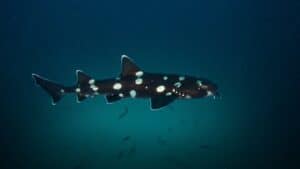
Off the Pacific coast of Central America, a sleek, all-black shark lurks in the deep. Named the Ninja Lanternshark, this species embodies stealth. Its uniformly dark skin provides excellent camouflage in the dimly lit twilight zone, nearly 1,000 meters below the surface. The “ninja” moniker, suggested by the young cousins of the lead researcher, perfectly captures its covert nature.
Unlike other lanternsharks that use prominent bioluminescent patterns for communication or camouflage, the Ninja Lanternshark has minimal glowing photophores. This subtle glow helps it blend into the faint ambient light, making it practically invisible to both prey and predators. This discovery highlights the diverse strategies deep-sea creatures use to survive in one of the planet’s most extreme environments.
The “Walking” Epaulette Sharks (Hemiscyllium ocellatum complex)

I
n the shallow, warm waters of the Indo-Australian archipelago, a group of newly discovered sharks has developed an astonishing ability: they can “walk.” Several new species of epaulette sharks have been identified, all sharing the remarkable trait of using their pectoral and pelvic fins to move across coral reefs and even on land during low tide.
This evolutionary marvel is a powerful adaptation for survival in complex, low-oxygen reef environments. By walking, these sharks can access isolated tide pools to hunt for crabs and other small invertebrates, a niche inaccessible to most other predators. This behavior demonstrates how life adapts in creative ways to exploit unique ecological opportunities, making these rare shark species a focal point of shark research into evolution and resilience.
How Scientists Find Newly Discovered Sharks
Identifying a new species isn’t a simple “eureka!” moment. It’s the result of rigorous scientific investigation, often combining cutting-edge technology with traditional methods. The process turns a mysterious specimen into a confirmed new branch on the tree of life.
The Technology Behind Modern Shark Discoveries
Modern marine science has a powerful toolkit for exploring the ocean and identifying its inhabitants.
- DNA Barcoding: This genetic technique is a game-changer for species identification. Scientists analyze a short, standardized section of an organism’s DNA. By comparing this genetic “barcode” to a global database, they can quickly determine if a specimen belongs to a known species or is entirely new. This is crucial for distinguishing between cryptic species—sharks that look nearly identical but are genetically distinct.
- Deep-Sea Submersibles: Remotely Operated Vehicles (ROVs) and Autonomous Underwater Vehicles (AUVs) are our eyes in the deep. These submersibles can withstand immense pressure and explore depths humans cannot reach, sending back high-definition video and collecting samples. The Ninja Lanternshark and many other deep-sea shark discoveries would have remained unknown without them.
- Satellite Tagging: While often used for tracking known species, satellite tags also play a role in new discoveries. By tracking sharks into previously unexplored habitats, researchers may encounter new species or identify populations that are genetically isolated, a precursor to forming a new species.
The Taxonomy Challenge: Classifying a New Species
Once a potential new species is found, the real work of shark research and taxonomy begins. Taxonomy is the science of naming, defining, and classifying organisms. To classify a new shark, scientists must prove it is unique through a meticulous process:
- Morphological Analysis: Researchers conduct detailed physical examinations, measuring everything from fin size and placement to snout length and tooth count. They compare these measurements to the closest known relatives.
- Genetic Sequencing: DNA analysis provides the definitive proof of a new lineage. Scientists sequence the specimen’s genome to show it is genetically distinct from all other known species.
- Holotype Designation: A single specimen, known as the “holotype,” is designated as the official representative of the new species. This specimen is preserved in a museum or research institution for future study.
- Peer Review and Publication: The findings are compiled into a scientific paper, which is then submitted to a journal for peer review. Other experts in the field scrutinize the evidence. If it holds up, the paper is published, and the new species is officially recognized by the scientific community.
Why These New Shark Discoveries Matter
The discovery of a new shark species sends ripples far beyond the world of marine biology. It has profound implications for our understanding of the planet and our responsibility to protect it.
Redrawing the Map of Marine Biology
Each new shark species adds a vital piece to the vast puzzle of evolution. These discoveries can challenge our assumptions about shark habitats, behavior, and their place in the food web. For example, the walking sharks show that not all sharks are open-ocean swimmers, and some are highly adapted to life in confined, shallow waters. These findings help scientists build a more accurate and complete picture of marine biodiversity and the evolutionary pathways that created it.
Conservation and Ecological Importance
Many newly discovered sharks are found in fragile and threatened ecosystems, such as deep-sea coral mounds and tropical reefs. Identifying a creature is the critical first step toward protecting it. Without a scientific name and a defined status, a species is invisible to conservation laws and initiatives.
Because many rare shark species have small populations and limited ranges, they are particularly vulnerable to threats like
overfishing, habitat destruction, and climate change. Protecting these sharks helps maintain the health of their entire marine ecosystem, as even the smallest species can play a crucial role in the food web.
Myth-Busting: What We Get Wrong About Sharks
Decades of sensationalized media have created a distorted public image of sharks. These new discoveries provide a perfect opportunity to debunk some common myths.
Myth 1: “All sharks are large apex predators.”
Fact: This couldn’t be further from the truth. The majority of the 500+ known shark species are less than a meter long. The newly discovered American Pocket Shark, at just 5.5 inches, is a prime example. Most sharks are not the fearsome predators of blockbuster movies but occupy diverse niches in the marine food web.
Myth 2: “We have already discovered all the major ocean species.”
Fact: This article proves that the age of discovery is far from over. Scientists estimate that we have identified less than 10% of the species living in the ocean. The deep sea, in particular, remains a vast frontier. Every year, new shark discoveries remind us that the ocean is full of mysteries waiting to be solved.
The Future of Ocean Discovery
The discovery of the glowing Pocket Shark, the stealthy Ninja Lanternshark, and the walking Epaulette Sharks underscores a powerful truth: our planet’s oceans are still a world of wonder. These findings are not just trivia for science enthusiasts; they are fundamental to understanding marine biology, ocean health, and the intricate web of life.
Each new species is a testament to evolution’s creativity and a reminder of how much we still have to learn. As technology continues to advance, the next decade promises even more incredible finds from the mysterious deep. We are left to wonder—what other secrets does the ocean hold, and what can they teach us about our world?
Frequently Asked Questions
What is the newest shark species discovered?
New shark species are described in scientific literature regularly. One of the most recent and notable is the American Pocket Shark (Mollisquama mississippiensis), officially described in 2019.
How many new shark species are discovered each year?
On average, scientists identify and describe around 15 to 20 new species of sharks, rays, and chimaeras annually, showcasing the ongoing nature of shark discoveries.
Where are most new shark species found?
Many new shark species are found in the deep sea, an environment that is largely unexplored. Others are discovered in biologically diverse and complex habitats like coral reefs in the Indo-Pacific region.
What is the rarest shark species in the world?
The Ganges shark is often cited as one of the rarest, but many newly discovered sharks, known only from a single specimen like the American Pocket Shark, are also contenders for this title.
How do scientists know if they’ve found a new species?
Scientists use a combination of morphological analysis (physical measurements) and DNA barcoding to compare a specimen to known species. If it is both physically and genetically distinct, it is classified as a new species.
Can a new shark be discovered in shallow water?
Yes. The “walking” epaulette sharks are a perfect example of new species discovered in shallow coral reef environments, proving that not all new discoveries come from the deep sea.
What technology is used for deep-sea shark discoveries?
Remotely Operated Vehicles (ROVs), submersibles, and advanced sonar mapping are key technologies that allow scientists to explore deep-sea environments and find new species.
Why is discovering new sharks important for the environment?
Discovering a new species is the first step toward conservation. It allows scientists to study its role in the ecosystem and advocate for measures to protect it and its habitat, which contributes to overall ocean health.
What is the strangest newly discovered shark?
The American Pocket Shark, with its ability to secrete a glowing fluid, is a strong candidate for the strangest. The “walking” sharks also rank high for their bizarre and unique mode of locomotion.
Does DNA analysis help in identifying new sharks?
Absolutely. DNA analysis, particularly DNA barcoding, is a crucial tool in modern taxonomy. It provides definitive genetic evidence to confirm whether a shark is a new species.