
Whale sharks are the gentle giants of the ocean, gliding through tropical waters with a calm majesty that captivates divers and marine biologists alike. Despite their immense size, these colossal fish are surprisingly delicate eaters. If you’ve ever wondered what whale sharks eat to fuel their massive bodies, the answer lies in some of the smallest organisms in the sea. This guide will explore the fascinating diet of the world’s largest fish. We will cover the primary food sources in the whale shark’s diet, from microscopic plankton to small fish. You’ll also learn about their unique feeding mechanisms and the incredible behaviors they display to find and consume their food. Understanding their diet is key to appreciating their vital role in marine ecosystems and the importance of conserving their habitats.
Overview — What Do Whale Sharks Actually Eat?
So, what do whale sharks eat? Despite their enormous size, their diet consists almost entirely of tiny marine life. The primary food source of whale sharks is plankton, including microscopic plants (phytoplankton) and animals (zooplankton). They also consume other small organisms they can filter from the water, such as krill, small shrimp, fish eggs, larvae, and schools of small fish like sardines and anchovies.
This feeding strategy makes them one of the ocean’s three species of large, filter-feeding sharks, alongside the basking shark and the megamouth shark. Instead of hunting large prey, they’ve evolved to efficiently strain huge volumes of water to capture nutrient-rich, tiny organisms. This passive approach to feeding is what allows them to grow so large while consuming such small food.
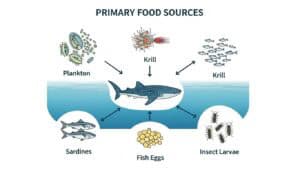
Whale Shark Diet: Main Food Sources
The whale shark diet is varied but always centers on small, abundant organisms. Their feeding habits often change based on seasonal availability and location.
1. Plankton (Primary Food)
Plankton is the cornerstone of the whale shark’s diet. This broad category includes:
- Zooplankton: Microscopic animals like copepods and other tiny crustaceans.
- Phytoplankton: Microscopic plants that form the base of the marine food web.
Whale sharks consume vast quantities of plankton, often targeting dense patches or “blooms” that occur seasonally. During these blooms, the water becomes a thick, nutrient-rich soup, providing an efficient feeding opportunity.
2. Krill & Small Shrimp
Krill, which are small, shrimp-like crustaceans, are another significant part of what whale sharks eat. These organisms form dense swarms that are an excellent, high-energy food source. In areas like the Antarctic and other cold-water upwelling zones, krill are incredibly abundant and attract numerous filter feeders, including whale sharks that migrate to these regions.
3. Small Fish & Sardines
While primarily plankton-eaters, whale sharks won’t pass up an easy meal of small, schooling fish. They are known to feed on:
- Sardines
- Anchovies
- Mackerel
- Small tunas
This behavior is often observed when fish are spawning, as the sharks can consume both the adult fish and the clouds of eggs they release. They use a technique called suction feeding to gulp down entire schools at once.
4. Fish Eggs & Larvae
During mass spawning events, particularly from coral and fish, the water becomes filled with eggs and larvae. Whale sharks are frequently seen congregating in these areas to take advantage of this temporary, high-protein food source. For example, at Ningaloo Reef in Australia, whale sharks time their arrival to coincide with the annual coral spawning, a major event that fills the water with edible material.
5. Copepods & Tiny Organisms
Copepods are tiny crustaceans that are a major component of zooplankton. They are one of the most abundant animal groups on the planet and form a critical part of the whale shark’s food source. Due to their small size, whale sharks must filter enormous volumes of water to consume enough copepods to sustain themselves.
How Do Whale Sharks Feed? (Feeding Mechanism)
The whale shark’s feeding mechanism is a marvel of natural engineering. Lacking the large, sharp teeth of predatory sharks, they have developed a highly efficient system for capturing tiny prey. Their primary method is filter-feeding, which can be performed in several ways.
Filter Feeding Explained
Filter-feeding is the process of straining food particles from water. Here’s how whale sharks filter feed:
- Opening Wide: A whale shark’s mouth can open up to 1.5 meters (nearly 5 feet) wide, allowing it to take in thousands of gallons of water in a single gulp.
- Filtering System: Inside its mouth are 20 specialized filter pads. These spongy, mesh-like structures are located along the gill arches and act like a sieve.
- Trapping Food: As water flows into the mouth and out through the gills, food particles larger than 2-3 millimeters are trapped by the filter pads.
- Swallowing: The shark then closes its mouth and swallows the collected mass of food.
This entire process is incredibly efficient, allowing the shark to capture a high volume of prey with minimal energy expenditure.
Active Feeding vs. Passive Feeding
Whale sharks exhibit two main whale shark feeding patterns:
- Active Feeding (Ram Filtration): In this mode, the shark swims forward with its mouth open, actively pushing water and food into its mouth. This is a common whale shark feeding behavior when food is more dispersed.
- Passive Feeding (Vertical Feeding): When food is highly concentrated, such as during a plankton bloom, whale sharks will often hang vertically in the water. They bob up and down, using a suction technique to draw water and food into their mouths without needing to swim forward. This conserves energy while maximizing food intake.
Suction Feeding (Rare Behavior)
While less common, whale sharks can also use powerful suction to capture prey. By rapidly opening and closing their mouths, they create a strong negative pressure that vacuums in nearby water and any fish or plankton within it. This is particularly effective for targeting dense schools of small fish that might otherwise scatter.
When & Where Do Whale Sharks Feed the Most?
Whale sharks eat, and their feeding habits are closely tied to their migration patterns and the seasonal availability of food. They are masters of finding hotspots where plankton and other food sources are most abundant.
- Seasonal Plankton Blooms: Whale sharks travel thousands of kilometers to follow seasonal plankton blooms. These blooms are often triggered by changes in water temperature and nutrient levels.
- Global Feeding Hotspots: Certain locations are famous for reliable whale shark sightings because they are critical feeding grounds. These include:
- Ningaloo Reef, Australia: Known for coral spawning events that attract whale sharks.
- Isla Mujeres, Mexico: Hosts one of the largest known aggregations of whale sharks, drawn by spawning fish.
- Donsol, Philippines: A key feeding ground where plankton is abundant.
- Galápagos Islands, Ecuador: A unique location where large, pregnant females are often seen, suggesting it may be an important feeding area before they give birth.
These migrations highlight how their survival is directly linked to the health of specific marine ecosystems around the world.
How Much Do Whale Sharks Eat Daily?
Estimating the exact daily food intake of a whale shark is challenging, but scientists believe they consume a significant amount to support their massive size. An adult whale shark, which can weigh over 20 tons, likely needs to eat several hundred pounds of plankton each day.
Their large size and slow metabolism allow them to go for long periods without eating, an essential adaptation for a life spent searching for patchy food sources across vast oceans. When they do find a dense patch of food, they will feed intensively to build up their energy reserves.
Interesting Feeding Facts
- Why do they have 3,000 tiny teeth? Despite being filter feeders, whale sharks have around 3,000 teeth arranged in over 300 rows. These teeth are tiny (less than 3 millimeters long) and are not used for chewing. Scientists believe they are vestigial structures, meaning they are evolutionary leftovers from their predatory ancestors.
- How do they detect food? Whale sharks have a powerful sense of smell. They can detect chemical signals released by plankton and spawning fish from miles away, helping them locate dense food “clouds” in the open ocean.
- Are they harmless to humans? Yes. Their feeding mechanism is designed for tiny prey, and they pose no threat to humans. Divers can safely swim alongside them.
The Right Diet for an Ocean Giant
The diet of a whale shark, centered on the smallest organisms in the ocean, is a perfect example of nature’s efficiency. Through their specialized filter-feeding mechanisms, these gentle giants play a crucial role in marine ecosystems by regulating plankton populations. Their peaceful nature and predictable feeding aggregations make them a wonder to behold, but also highlight their vulnerability to changes in ocean health.
Protecting the plankton-rich waters they depend on is essential for ensuring the survival of the world’s largest fish. By understanding what whale sharks eat and how they live, we can better appreciate and protect these magnificent creatures for generations to come.
People Also Ask
Do whale sharks eat humans?
No, whale sharks do not eat humans. They are filter feeders with a throat too small to swallow a person, and they show no aggression toward humans.
How do whale sharks filter feed?
Whale sharks filter feed by swimming with their massive mouths open to take in water filled with plankton and small fish. The water is then expelled through their gills, while filter pads trap the food, which is then swallowed.
What is the whale shark’s favorite food?
While they eat a variety of small organisms, plankton is considered their primary and favorite food source. They travel great distances to find dense blooms of it.
Do whale sharks eat plankton only?
No, their diet is not limited to plankton. They also eat krill, fish eggs, copepods, and small schooling fish like sardines and anchovies.
Can a whale shark bite?
Whale sharks have thousands of tiny, non-functional teeth and cannot bite in the traditional sense. They feed by filtering or suctioning, not by biting or chewing prey.
How big is a whale shark’s mouth?
A whale shark’s mouth can be up to 1.5 meters (almost 5 feet) wide, allowing it to engulf huge volumes of water while feeding.
Do whale sharks eat jellyfish?
Yes, whale sharks have been observed feeding on jellyfish, which are another form of zooplankton that they can easily filter from the water.